Autoregressive generation produces output one token at a time, feeding each generated token back as input for the next step.
Process:
- Given prompt tokens , run forward pass → get probability distribution over next token
- Sample or select from this distribution
- Append to the sequence
- Repeat until stop token or max length
Sampling strategies:
| Method | Description | Effect |
|---|---|---|
| Greedy | Pick argmax at each step | Deterministic, often repetitive |
| Temperature | Divide logits by before softmax | : sharper (more deterministic). : flatter (more random) |
| Top-k | Sample from the most probable tokens | Limits tail randomness |
| Top-p (nucleus) | Sample from smallest set with cumulative prob | Adaptive k — more tokens when distribution is flat |
KV cache: at each step, only the new token's Q needs computation — K and V from previous positions are cached. This turns generation from per step to .
# Pre-allocate per-layer cache of shape (batch, num_heads, max_seq_len, head_dim)
def forward_with_cache(model, new_token, kv_cache, position):
    x = model.embed(new_token)              # (batch, 1, d_model) — just the new token
    for i, layer in enumerate(model.layers):
        q, k, v = layer.qkv_proj(x).chunk(3, dim=-1)
        kv_cache[i]['k'][:, :, position, :] = k.squeeze(2)   # write new K, V
        kv_cache[i]['v'][:, :, position, :] = v.squeeze(2)
        k_full = kv_cache[i]['k'][:, :, :position + 1, :]     # attend over all cached
        v_full = kv_cache[i]['v'][:, :, :position + 1, :]
        x = layer.ffn(attention(q, k_full, v_full))
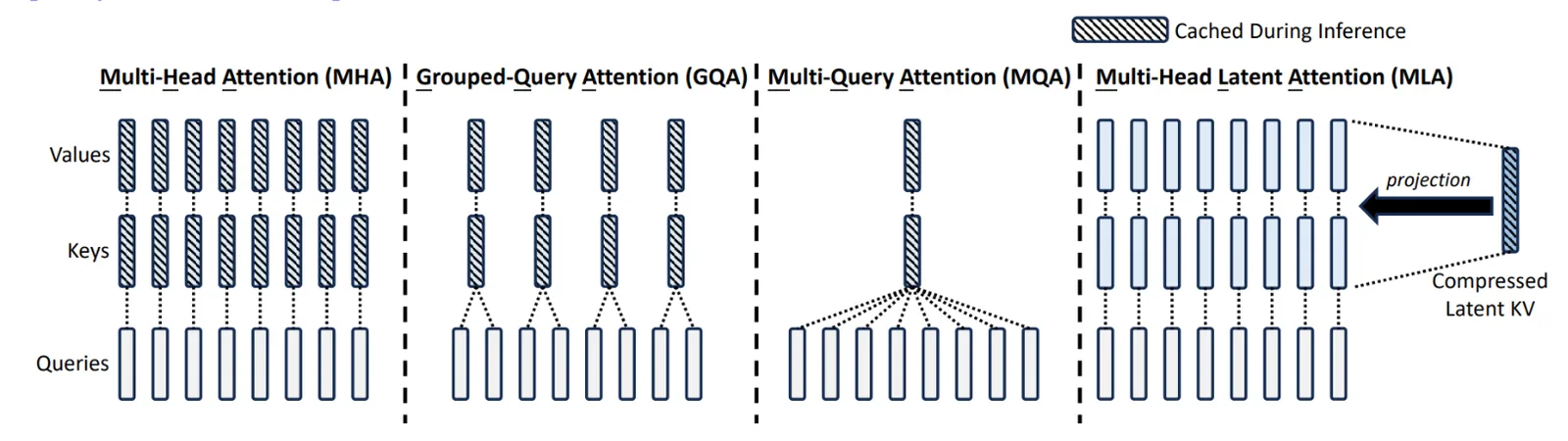
return model.lm_head(x)Shrinking the KV cache (it scales as num_layers × num_kv_heads × seq_len × head_dim × 2):
- MHA — every head has its own K, V (largest cache)
- MQA — all heads share one K, V → cache shrinks by
num_heads - GQA — heads grouped, each group shares K, V (middle ground; the modern default)
- MLA (DeepSeek) — cache a small latent vector per token, project back up to full K, V at decode time (not compatible with RoPE)
Autoregressive = left-to-right generation. This is why decoder-only models need Causal Masking during training: it simulates the generation setting where future tokens are unavailable.
Limitation: sequential generation is slow. Each token requires a full forward pass. Test-Time Compute explores ways to use more compute per generation.
Speculative decoding speeds this up losslessly by exploiting that scoring (prefill) is cheaper than generation: a small draft model proposes tokens, then the target model verifies them in one parallel forward pass. Each draft token is accepted with probability ; on the first rejection, resample from the normalized residual . The acceptance rule is constructed so the emitted distribution is exactly — same output distribution as the target, but several tokens per target call when the draft agrees.
See also: Causal Masking, Pretraining, Self-Attention